API Reference
A pathlib-first library for working with file sequences.
Path sequence classes come in two variations depending on the format of sequence string they support: simple, which prioritises simplicity to guarantee behaviour; or loose, which prioritises compatibility with more file names. Both variations share common base classes.
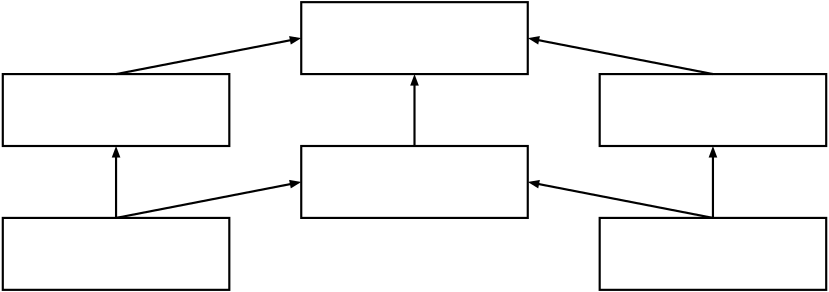
If you aren’t sure which variation is right for you, choose simple if you have control over the format of sequence strings that you support, and choose loose if you don’t.
The simple and loose variants both come in a pure
and concrete form, similar to the classes in pathlib.
Pure path sequences contain pathlib.PurePath objects,
and concrete path sequences contain pathlib.Path objects.
Pure Path Sequences
- type pathseq.PurePathT_co = TypeVar(PurePathT_co, bound=pathlib.PurePath, covariant=True)
The type of pure paths contained in a
BasePurePathSequence.
- class pathseq.BasePurePathSequence(path: str)
- class pathseq.BasePurePathSequence(path: PurePathT_co)
Bases:
Sequence[PurePathT_co]A generic class that represents a path sequence.
- Raises:
NotASequenceError – When the given path does not represent a sequence.
ParseError – When the given path is not a valid path sequence.
- property parts: tuple[str, ...]
A tuple giving access to the sequence’s various components.
>>> s = PurePathSequence(PurePosixPath('/path/to/image.1-3####.exr'))
>>> s.parts
('/', 'path', 'to', 'image.1-3####.exr')
- property name: str
A string representing the final path component, excluding the drive and root.
Given that a sequence’s final path component must be the sequence’s files, the name will always be a valid sequence string.
>>> PurePathSequence('/path/to/image.1-3####.exr').name
'image.1-3####.exr'
- property stem: str
The name, without any ranges, suffixes, or range strings.
>>> PurePathSequence('/path/to/images.1-3####.exr').stem
'images'
- property file_num_seqs: Sequence[FileNumSequence[int] | FileNumSequence[Decimal]]
All file number sequences in the name.
>>> PurePathSequence('/path/to/texture.1011-1013<UDIM>_1-3#.tex').file_num_seqs
(FileNumSequence(1011-1013), FileNumSequence(1-3))
- property suffix: str
The file extension of the paths in the sequence.
A simple path sequence will always have a file extension. Therefore this will never return the empty string.
>>> PurePathSequence('/path/to/image.1-3####.exr').suffix
'.exr'
- property suffixes: Sequence[str]
A list of the file extensions of any path in the sequence.
>>> PurePathSequence('/path/to/file.1-3####.tar.gz').suffixes
('.tar', '.gz')
- property parents: Sequence[PurePathT_co]
An immutable sequence providing access to the logical ancestors of the sequence.
>>> s = PurePathSequence(PureWindowsPath('c:/path/to/images.1-3####.exr'))
>>> s.parents[0]
PureWindowsPath('c:/path/to')
>>> s.parents[1]
PureWindowsPath('c:/path')
>>> s.parents[2]
PureWindowsPath('c:/')
- property parent: PurePath
The logical parent of the sequence.
>>> s = PurePathSequence(PurePosixPath('/a/b/c/d.1-3#.exr'))
>>> s.parent
PurePosixPath('/a/b/c')
- as_posix() str
Return a string representation of the sequence with forward slashes (/).
>>> s = PurePathSequence(PureWindowsPath('c:\\windows\\images.1-3#.exr'))
>>> str(s)
'c:\\windows\\images.1-3#.exr'
>>> s.as_posix()
'c:/windows/images.1-3#.exr'
- is_relative_to(other: PurePath) bool
Return whether or not all files in this sequence are relative to the other path.
- Raises:
ValueError – If this path sequence is given. The paths in a sequence cannot be relative to a sequence.
- relative_to(other: str | PathLike[str], *, walk_up: bool = False) Self
Compute a version of this path relative to the path represented by
other.Note
walk_up is available only in Python 3.12 and newer.
- Raises:
ValueError – When this sequence cannot be relative to the given path.
- with_name(name: str) Self
Return a new sequence with the
namechanged.Given that a sequence’s final path component must be the sequence’s files, the given name must also be a valid sequence string.
- Raises:
ValueError – When the given name is empty. Use
parentinstead.NotASequenceError – When the given name does not represent a sequence.
ParseError – When the resulting path is not a valid path sequence.
- with_stem(stem: str) Self
Return a new path with the
stemchanged.>>> p = PurePathSequence('images.1-3#.exr') >>> p.with_stem('textures') PurePathSequence('textures.1-3#.exr')
- Raises:
ValueError – If the new stem is invalid.
- with_file_num_seqs(*seqs: FileNumSequence[int] | FileNumSequence[Decimal]) Self
Return a new sequence with the file number sequences changed.
- Raises:
TypeError – If the given number of file number sequences does not match the sequence’s number of file number sequences.
- path_with_file_nums(*numbers: int | Decimal) PurePathT_co
Return a path for the given file number(s) in the sequence.
- Parameters:
numbers – The number to use in place of each range in the string.
>>> p = PurePathSequence(PurePosixPath('images.1-3#.exr'))
>>> p.path_with_file_nums(5)
PurePosixPath('images.5.exr')
- with_suffix(suffix: str) Self
Return a new path sequence with the suffix changed.
If the given suffix is the empty string, the existing suffix will be removed. But if the path sequence has only one suffix, then a
ValueErrorwill be raised because removing the suffix will result in an invalid path sequence.- Parameters:
suffix – The new suffix to replace the existing suffix with.
- Raises:
ValueError – If the given suffix would result in an invalid path sequence.
Concrete Path Sequences
- type pathseq.PathT_co = TypeVar(PathT_co, bound=pathlib.Path, covariant=True)
The type of concrete paths contained in a
BasePathSequence.
- class pathseq.BasePathSequence(path: str)
- class pathseq.BasePathSequence(path: PathT_co)
Bases:
BasePurePathSequence[PathT_co]A sequence of Path objects.
- Raises:
NotASequenceError – When the given path does not represent a sequence, but a regular path.
ParseError – When the given path is not a valid path sequence.
- expanduser() Self
Return a new sequence with expanded
~and~userconstructs.The expansion will be as returned by
os.path.expanduser().- Raises:
RuntimeError – If a home directory can’t be resolved.
- absolute() Self
Return a new sequence with the sequence’s paths made absolute.
Normalisation and symlink resolution are not performed.
- iter_existing_paths() Iterable[PathT_co]
Iterate over the ranges of files that exist on disk.
This method will ignore the file number sequences in this path sequence, and iterate over all paths that could be represented by the sequence string and exist on disk.
Users who wish the file number sequences to be taken into account can use the existing
__iter__()method and filter the results by whether they exist on disk.
- resize_from_existing_paths() tuple[Self, Completeness]
Return a new a sequence using the ranges of files that exist on disk.
Each file number sequence in the path sequence will be ordered numerically.
Note
This method requires storing all file numbers in memory, so it may not be suitable for sequences with large numbers of files. Consider using
iter_existing_paths()instead if memory usage is a concern.- Returns:
A tuple of the new path sequence and a
Completenessvalue indicating whether or not the sequence is complete on disk. A sequence may be partially complete when:The given sequence represents a single path, and that path does not exist on disk.
One or more dimensions in a multi-dimension sequence does not have a consistent number of files in each other dimension. For example, a sequence
file.1-2#_1-2#.exrwould be partially complete if only the filesfile.1_1.exr,file.1_2.exr, andfile.2_1.exrexist on disk, butfile.2_2.exrdoes not.
Simple Path Sequences
- class pathseq.PurePathSequence(path: str)
- class pathseq.PurePathSequence(path: PurePathT_co)
Bases:
BasePurePathSequence[PathT_co]A sequence of PurePath objects.
- Raises:
NotASequenceError – When the given path does not represent a sequence, but a regular path.
ParseError – When the given path is not a valid path sequence.
- property parsed: ParsedSequence
The parsed sequence string, as a tree of objects.
- class pathseq.PathSequence(path: str)
- class pathseq.PathSequence(path: PathT_co)
Bases:
PurePathSequence[PathT_co],BasePathSequence[PathT_co]A sequence of Path objects.
- Raises:
NotASequenceError – When the given path does not represent a sequence, but a regular path.
ParseError – When the given path is not a valid path sequence.
Loose Path Sequences
- class pathseq.LoosePurePathSequence(path: str)
- class pathseq.LoosePurePathSequence(path: PurePathT_co)
Bases:
BasePurePathSequence[PurePathT_co]A sequence of PurePath objects.
- Raises:
NotASequenceError – When the given path does not represent a sequence, but a regular path.
ParseError – When the given path is not a valid path sequence.
- property parsed: ParsedLooseSequence
The parsed sequence string, as a tree of objects.
- property suffix: str
The file extension of the paths in the sequence.
If there is no suffix, this will be the empty string.
>>> LoosePurePathSequence('file1-3###').suffix
''
- with_suffix(suffix: str) Self
Return a new path sequence with the suffix changed.
If the given suffix is the empty string, the existing suffix will be removed. But if the path sequence has only one suffix, then a
ValueErrorwill be raised because removing the suffix will result in an invalid path sequence.- Parameters:
suffix – The new suffix to replace the existing suffix with.
- Raises:
ValueError – If the given suffix would result in an invalid path sequence.
- property stem: str
The final path component, without any pre-range separator, ranges, post-range separator, or suffixes.
>>> LoosePurePathSequence('/path/to/images.1-3####.exr').stem
'images'
>>> LoosePurePathSequence('/path/to/1-3####_images.exr').stem
'images'
>>> LoosePurePathSequence('/path/to/images.exr.1-3####').stem
'images'
If the ranges do not start or end the path then, unlike
pathlib.PurePath.stem, this will never contain a suffix if the range is in the path and the paths have multiple suffixes:>>> LoosePurePathSequence('/path/to/images.1-3####.tar.gz').stem 'images' >>> LoosePurePathSequence('/path/to/1-3####_images.tar.gz').stem 'images.tar' >>> LoosePurePathSequence('/path/to/images.tar.gz.1-3####').stem 'images.tar'
If the paths have no stem, then the empty string is returned:
>>> LoosePurePathSequence('1-3#.tar.gz').stem
''
- class pathseq.LoosePathSequence(path: str)
- class pathseq.LoosePathSequence(path: PathT_co)
Bases:
LoosePurePathSequence[PathT_co],BasePathSequence[PathT_co]A sequence of Path objects.
- Raises:
NotASequenceError – When the given path does not represent a sequence, but a regular path.
ParseError – When the given path is not a valid path sequence.
Exceptions
- exception pathseq.NotASequenceError(seq: str)
Bases:
ParseErrorRaised when parsing a string that does not represent a sequence, but a regular path.
In other words, the given sequence string has no range present.
- exception pathseq.ParseError(seq: str, column: int, end_column: int = -1, reason: str | None = None)
Bases:
ValueErrorRaised when parsing a sequence string fails.
- Parameters:
seq – The sequence string that failed parsing.
column – The index of the character of the part of the string that failed parsing.
end – The index of the last character of the part of the string that failed parsing.
reason – A human readable explanation of why parsing failed.
File Number Sequences
- type pathseq.FileNumT = TypeVar(FileNumT, int, decimal.Decimal)
The type of file numbers in a
FileNumSequence.
- class pathseq.FileNumSequence
Bases:
Sequence[FileNumT]A sequence of file numbers.
Warning
The constructor is not considered public. Instead, use the
from_str()andfrom_file_nums()class methods.- classmethod from_str(seq: str) FileNumSequence[int] | FileNumSequence[Decimal]
Parse a range string in a file number sequence.
- Parameters:
seq – The range string to parse (e.g. ‘1001-1005,1010-1015’).
- Returns:
The resulting file number sequence.
- classmethod from_file_nums(file_nums: Iterable[FileNumT]) FileNumSequence[FileNumT]
Create a file number sequence from an iterable of file numbers.
The given numbers are put into the sequence in the order they are provided.
- Parameters:
file_nums – The file numbers to turn into a sequence.
- Returns:
The resulting file number sequence.
- static has_subsamples(file_num_seq: FileNumSequence[int] | FileNumSequence[Decimal]) TypeGuard[FileNumSequence[Decimal]]
Check whether this file number sequence contains any decimal numbers.
Parsed Path Sequences
These classes represent a parsed path sequence in a tree structure. Access to a parsed sequence can be useful for renaming sequences or converting sequence strings between different formats.
See also
See Sequence String Formats for the specification of what is valid in each part of a sequence.
- class pathseq.ParsedSequence(stem: str, pre_range: Literal['', '_', '.'], ranges: Ranges, suffixes: tuple[str, ...])
A parsed path sequence.
- pre_range: Literal['', '_', '.']
An optional single character separator between the stem and the ranges.
- suffixes: tuple[str, ...]
The file extensions of the files in the path sequence.
Each suffix includes the leading “
.”.
- with_stem(stem: str) Self
Return a new parsed sequence with the
stemchanged.If the stem is removed, the pre-range separator will be as well.
- with_suffix(suffix: str) Self
Return a new parsed sequence with the suffix changed.
- Parameters:
suffix – The new suffix to replace the existing one with. This must start with a “.” or be the empty string.
- Raises:
ValueError – If an invalid suffix is given.
- type pathseq.ParsedLooseSequence = pathseq.RangesStartName | pathseq.RangesInName | pathseq.RangesEndName
- class pathseq.RangesStartName(pre_range: Literal[''], ranges: Ranges, post_range: Literal['_', ''], stem: str, suffixes: tuple[str, ...])
A parsed loose path sequence where the range starts a path’s name.
- pre_range: Literal['']
An optional single character separator between the ranges and the previous component.
This is always empty for file names where the ranges start the name, but is included so that
RangesStartName,RangesInName, andRangesEndNameall have the same attributes.
- post_range: Literal['_', '']
An optional single character separator between the ranges and the next component.
In sequences where the ranges start the name, this separates the ranges from the stem.
- stem: str
The name of the sequence, without the pre-range separator, ranges, post-range separator, and suffixes.
- suffixes: tuple[str, ...]
The file extensions of the files in the path sequence.
Each suffix includes the leading “
.”.
- with_stem(stem: str) Self
Return a new parsed sequence with the
stemchanged.If the stem is removed, the post-range separator will be as well.
- with_suffix(suffix: str) Self
Return a new parsed sequence with the suffix changed.
- Parameters:
suffix – The new suffix to replace the existing one with. This must start with a “.” or be the empty string.
- Raises:
ValueError – If an invalid suffix is given.
- class pathseq.RangesInName(stem: str, pre_range: str, ranges: Ranges, post_range: str, suffixes: tuple[str, ...])
A parsed loose range sequence where the range follows a path’s stem.
- stem: str
The name of the sequence, without the pre-range separator, ranges, post-range separator, and suffixes.
- pre_range: str
An optional single character separator between the ranges and the previous component.
In sequences where the ranges are in the name, this separates the ranges from the stem.
- post_range: str
An optional separator between the ranges and the next component.
In sequences where the ranges are in the name, this separates the ranges from the suffixes.
- suffixes: tuple[str, ...]
The file extensions of the files in the path sequence.
Each suffix includes the leading “
.”.
- with_stem(stem: str) Self
Return a new parsed sequence with the
stemchanged.If the stem is removed, the pre-range separator will be as well.
- with_suffix(suffix: str) Self
Return a new parsed sequence with the suffix changed.
- Parameters:
suffix – The new suffix to replace the existing one with. This must start with a “.” or be the empty string.
- Raises:
ValueError – If an invalid suffix is given.
- class pathseq.RangesEndName(stem: str, suffixes: tuple[str, ...], pre_range: str, ranges: Ranges, post_range: Literal[''])
A parsed loose range sequence where the range ends a path’s name.
- stem: str
The name of the sequence, without the pre-range separator, ranges, post-range separator, and suffixes.
- suffixes: tuple[str, ...]
The file extensions of the files in the path sequence.
Each suffix includes the leading “
.”.
- pre_range: str
An optional single character separator between the ranges and the previous component.
In sequences where the ranges are in the name, this separates the ranges from the suffixes.
- post_range: Literal['']
An optional separator between the ranges and the next component.
This is always empty for file names where the ranges end the name, but is included so that
RangesStartName,RangesInName, andRangesEndNameall have the same attributes.
- with_suffix(suffix: str) Self
Return a new parsed sequence with the suffix changed.
- Parameters:
suffix – The new suffix to replace the existing one with. This must start with a “.” or be the empty string.
- Raises:
ValueError – If an invalid suffix is given.
- class pathseq.PaddedRange(file_nums: 'FileNumSequence[FileNumT]', pad_format: 'str')
- file_nums: FileNumSequence[FileNumT]
The file numbers of each file in the sequence.
- pad_format: str
The definition of how a file number is formatted in each file’s name in the sequence.
- static has_subsamples(range_: PaddedRange[int] | PaddedRange[Decimal]) TypeGuard[PaddedRange[Decimal]]
Check whether this file number sequence contains any decimal numbers.
- class pathseq.Ranges(ranges: 'tuple[PaddedRange[int] | PaddedRange[decimal.Decimal], ...]', inter_ranges: 'tuple[str, ...]')
- ranges: tuple[PaddedRange[int] | PaddedRange[Decimal], ...]
Each range specifier in the sequence.
Formatter
- class pathseq.Formatter
A
Formatterformats a parsed sequence into a string.The purpose of the class is primarily for converting from a simple or loose sequence into other sequence formats by overriding this class.
Example
>>> class HoudiniFormatter(pathseq.Formatter):
...   def range(self, range_):
...       return "$F"
...
>>> seq = pathseq.PathSequence("image.1-5#.exr")
>>> HoudiniFormatter().format(seq.parsed)
'image.$F.exr'
- include_all_suffixes
Whether to include all suffixes in the formatted sequence.
This is set by
format()to indicate whether the suffixes have been cleanly separated from the stem or not. If this isFalse, then thestemandsuffixeswill overlap and both include all but the last suffix.
- range(range_: PaddedRange[int] | PaddedRange[Decimal]) str
- format(seq: ParsedSequence | ParsedLooseSequence) str
Format the given path sequence into a string.
The parsed sequence is traversed, and each node is formatted according to the implementation of the associated method on this class.
- Parameters:
seq – The path sequence to format into a string.
- Returns:
The formatter path sequence.